# Haedal Protocol

The Ultimate Place to Stake & Earn on Sui

Haedal is a prime liquid staking protocol natively built on Sui. It allows anyone to stake their SUI tokens to contribute to the governance and decentralization of the Sui blockchain. In the meantime, users will get haSUI as the liquid staking token in return so that they can continue to participate in various DeFi activities to earn additional income with their LST liquidity.

On top of its liquid staking protocol, Haedal is also building a series of wingman products including Haedal Market Maker and more, which generate continuous additional on-chain yields for Haedal and its LST ecosystem.&#x20;

Haedal serves as a core pillar of the Sui DeFi by merging native liquid staking and yield strategies with user-friendly accessibility. Our mission is to empower users to maximize capital efficiency through innovative liquid staking and algorithmic DeFi yield solutions, and build Haedal into the ultimate place to stake and earn on Sui.


# Links

#### Website:&#x20;

<https://haedal.xyz/>

#### Application: &#x20;

<https://haedal.xyz/stake>

#### Discord:

<https://discord.gg/haedalprotocol>

#### Medium:

<https://medium.com/@haedal>

#### Twitter:

<https://x.com/HaedalProtocol>

{% embed url="<https://x.com/HaedalProtocol>" %}


# Introduction

With Haedal’s liquid staking infrastructure, users are able to stake their SUI tokens through Haedal to validators on Sui with one click to earn consensus rewards while keeping their liquidity active for various DeFi use cases.

Haedal allows all users to benefit from the blockchain validation with no need to run or maintain a validator by themselves. By simply staking through the smart contract, users can contribute to the consensus of the Sui Network. After staking SUI, users will receive haSUI in return, a liquid staking token as a staking receipt, which can be freely used in various DeFi scenarios to generate DeFi yields.


# Why Liquid Staking

The Sui Network uses a delegated proof-of-stake (DPoS) mechanism for its blockchain consensus. To maintain the decentralization and security of the Sui blockchain, we need to stake as many SUI tokens as possible with stable and efficient validators.

However, most common users do not have the capability, experience or time to deploy and maintain their own validator hardware and software to participate in blockchain validation. On most layer1 or layer2 blockchain, this is conducted by professional node service providers and experienced devops engineers. As blockchain and DeFi are fully open and transparent to all users, is there a way for ordinary users to join the chain consensus and benefit from this economy?

This is where liquid staking steps in. With liquid staking protocols like Haedal, users don't need to care about the technical implementation regarding validators. They can simply delegate their SUI tokens to liquid staking protocols to stake to validators to earn consensus rewards. More importantly, the value of their assets will not be completely locked as inactive status. Instead, the value can be released back to the ecosystem in the form of haSUI liquidity, which can be used in a variety of DeFi scenarios. Users don't need to make tradeoffs between staking in validators or providing liquidity in DeFi protocols. With liquid staking, they can achieve both or even multiple in a DeFi composability manner.

When users stake their SUI with Haedal, Haedal selects multiple validators that perform stably and efficiently through a reliable algorithm. The staked SUI tokens from users will be distributed across these validators, with periodic adjustments to the distribution.

The process of users staking through liquid staking protocol is also a process of contributing to network robustness and stability.


# haSUI

All SUI can be haSUI. haSUI is a liquid staking token that users receive when they stake SUI through Haedal’s liquid staking infra, which represents users’ staked SUI in Haedal's staking pool.&#x20;

These tokens essentially serve as receipts, providing users with the ability to redeem them in the future for their staked SUI along with any accrued rewards. As time goes by, the value of haSUI will continue to appreciate relative to SUI based on its value-accrual mechanism. In the meantime, haSUI is fully usable as active liquidity within the Sui DeFi ecosystem, unlocking SUI’s value to achieve optimized capital utilization.

<br>


# Value Accruing

haSUI is a value-accruing (or reward-accruing) liquid staking token. The accumulated staking rewards are appreciated onto the value of haSUI. This means that following each Sui epoch, its valuation undergoes a recalculation based on the staking rewards earned through the Haedal Staking Pool.

#### **The value of haSUI is calculated as follows:**

$$
haSUIConversionRate=\[totalStakedSUI+totalStakingRewards\*(1-CommissionPercentage)-totalUnstakedSUI]/haSUIMinted)
$$

Where:

* haSUIConversionRate means the native conversion rate between haSUI and SUI through Haedal's liquid staking system
* totalStakedSUI is the amount of SUI staked by users through Haedal.
* total\_StakingRewards is the accumulated staking rewards earned from Sui nodes.
* totalUnstakedSUI is the amount of SUI users have unstaked through the protocol.
* CommissionPercentage is the liquid staking protocol fee, which is 6% of total rewards earned from validators.
* haSUIMinted is the current supply of haSUI tokens.

Therefore, the exchange rate of haSUI versus SUI will increase as time goes by because of the staking rewards accrued.

#### **haSUI's market price**

As described above, haSUI follows a value accruing model based on the liquid staking mechanism. Its conversion rate relative to SUI is expected to continuously increase over time. However, in an open secondary market like DEX or CEX, the market price of haSUI mainly depends on user behavior and overall market conditions.

Since users can always unstake haSUI back to native SUI tokens via Haedal’s liquid staking infra, haSUI has an inherent exchange rate support. If the price of haSUI price on secondary markets deviates significantly, traders and arbitragers will naturally engage in price correction, aligning the market price with the intrinsic value of haSUI.


# What Can Users Do With haSUI

haSUI tokens have various use cases in the SUI ecosystem. Users will be able to access all the DeFi protocols with haSUI while earning stable staking rewards. haSUI can be used for almost all DeFi use cases that can be achieved by SUI, thereby fully unleashing the on-chain liquidity.

* Liquidity Provision: Provide liquidity on DEX to earn continuous trading fee revenue.
* Trading on DEX: It can be used on any decentralized exchanges or trading platforms to exchange for other crypto assets, serving as a main quote token on Sui.
* Borrowing/Lending: Users can lend haSUI to other users via different lending protocols on Sui to earn lending interest. It can also be used as collateral to borrow other mainstream assets on Sui.
* Collateralized Debt Position (CDP): Used as collateral to mint stablecoin or other assets, thereby boosting capital efficiency.
* Yield Trading: haSUI has been supported by major yield trading protocols on Sui
* More


# APY Calculation

Haedal calculates its liquid staking APY by comparing the current conversion rate of haSUI/SUI with the rate from 48 hours ago. This method reflects the growth rate of haSUI relative to SUI over the past two days, providing users with an accurate measure of the protocol's yield performance. This calculation helps in tracking the yield accumulation and gives users insight into their potential returns over a specific period.


# Stake

Users can stake SUI through Haedal's infrastructure, and it will mint haSUI based on the current epoch's haSUI/SUI ratio. Haedal will delegate the staked assets to validators to start earning staking rewards.

When staking, users can choose between two modes: **"Automated"** and **"Manual"**.

### Automated

With the "Automated" stake mode, the user's staked SUI tokens will be automatically distributed across multiple validators with stable and efficient performance selected by a reliable algorithm. The distribution will be periodically re-adjusted.

### Manual

The "Manual" stake mode allows users to select specific validators from the list by themselves for direct staking.

<br>


# Unstake

### Regular Unstake

Users can unstake their haSUI to get back SUI freely. The regular unstake operation incurs no fee, but requires a waiting period of 1-2 epochs to cancel the stake.

When a user submits an unstake request, Haedal will burn the submitted haSUI and issue a claim object to the user. When the waiting period finishes, the user (with the specific claim object in account) will be able to claim their SUI tokens back. The amount of SUI tokens that can be withdrawn via unstaking is calculated as:

$$
SUIamount=haSUIBurntAmount\*haSUIConversionRate
$$

There are three scenarios for "Withdraw by Unstake":

* If the unstake request is made at the start of epoch n, the user will receive their staked assets in epoch n+1. However, the haSUI exchange rate for epoch n will not be updated, and the user will receive their assets based on the haSUI exchange rate of epoch n-1.
* If the unstake request is made during epoch n, the user will receive their assets in epoch n+1.
* If the unstake request is made in the last 4 hours of epoch n, the user will receive their assets in epoch n+2.

### Instant Unstake

Besides the regular unstake, Haedal also supports SIP33 on Sui to allow for instant unstake. The SIP33 allows inactive StakedSui objects to be redeemed immediately. This creates the premise for instant unstake. Users can opt for instant unstake with a small unstaking fee when they need their SUI urgently.&#x20;

The instant unstaking fee is currently set as 0.02% of the unstaking amount of each request.


# haWAL

**haWAL** is the liquid staking token users receive when they stake **WAL** through Haedal’s liquid staking infrastructure. It represents a user’s staked WAL and automatically accrues staking rewards from Walrus Protocol over time.


# Value Accruing & Use Cases

### Value Accrual

The value of haWAL increases relative to WAL as staking rewards from the Walrus Protocol continuously accumulate. After each Walrus epoch, Haedal's liquid staking system updates the haWAL/WAL exchange rate to reflect newly earned rewards (minus a small commission fee, currently at 6%). This means that from a mechanism perspective, the value of haWAL is constantly increasing relative to WAL — no manual claiming needed.

### What You Can Do with haWAL

haWAL is designed to be composable within the Sui DeFi ecosystem. Users can:

* **Provide Liquidity**: Provide haWAL liquidity on DEXs to earn trading fees.
* **Trade**: Swap haWAL with any token on DEXs or aggregators.
* **Borrow/Lend**: Use haWAL in lending markets to earn yield or as collateral.
* **Mint Stablecoins**: Use haWAL as collateral in CDP-based protocols to mint new assets
* **Yield Trading:** haWAL has been supported by major yield trading protocols on Sui
* **More**


# Stake & Unstake

## Stake

Users can stake WAL to mint haWAL on Haedal instantly. In the default 'Automated' mode, users' WAL will be automatically staked to the top validators delivering the best APR in the current epoch. In the 'Manual' mode, users can select their preferred validator to stake their WAL with.&#x20;

## Unstake

Users can unstake their haWAL via Haedal to redeem WAL based on the real-time native exchange rate. Depending on the unstake options, there will be different waiting period before the unstaked WAL is fully claimable. &#x20;

### **Regular Unstake**&#x20;

This is the standard unstaking option, which is available at any time and does not incur any extra fees.&#x20;

The 'Regular Unstake' has a waiting period of 1–2 epochs before the unstaked WAL become claimable. One epoch of Walrus Protocol lasts 14 days currently.&#x20;

Staking/unstaking requests made before the midpoint of each epoch take effect from the next Epoch, while those submitted after the epoch will be deferred to the Epoch after the next.

### **Instant Unstake**

Similar to the SIP33 of Sui liquid staking, users can access 'Instant Unstake' of haWAL via Haedal with a slight unstaking fee (currently at 0.02%). It should be noted that the amount available for instant unstake may be limited in real time. Available amount for instant unstake depends on how much WAL has been newly submitted for staking in the current epoch. When the capacity is reached, instant unstake will be temporarily unavailable until there is new WAL to be submitted on Haedal for liquid staking.&#x20;

## haWAL Contract Interface

<https://github.com/haedallsd/hawal-interface>


# Introduction

HMM (Haedal Market Maker) is a specially made automated market maker which can not only maximize the capital efficiency on Sui but can also dramatically boost yields for all Haedal users. It is fueled by Haedal's protocol-owned liquidity, aiming to generate substantial additional yields for haSUI. It's not only empowering Haedal's own economy, but also reshapes the liquidity landscape and promotes liquid staking development on Sui.

HMM transforms market volatility into sustainable yield for haSUI holders. It has significant advantages in the following aspects:

* **High Capital Efficiency:** HMM can achieve equivalent capital efficiency that can be compared to the liquidity in ultra-narrow ranges in CLAMM pools, while maintaining much higher flexibility. It easily beats traditional AMMs in terms of efficiency, with superior liquidity utilization that is improved hundreds of times.
* **Low Drawdown:** Leveraging Sui’s robustness and high TPS, HMM can swiftly adjust the liquidity distribution in pools by capturing price fluctuations in volatile pairs (e.g., SUI-USDC), effectively controlling risks and minimizing the drawdown caused by volatility.
* **Anti-MEV:** HMM is naturally resistant to MEV. It can effectively defend against various types of front-run and sandwich attacks, ensuring uncompromised yield performance.

HMM’s superior advantages in DeFi adoption are mainly achieved through the following technologies and mechanisms: dynamic liquidity concentration, oracle-based proactive pricing, and inventory management.


# HMM Mechanism

## Dynamic Liquidity Concentration

In traditional orderbooks, capital naturally concentrates around the current price, driven by traders’ natural pursuit for efficiency and utilization. When it comes to DeFi, a similar liquidity depth distribution can be achieved through liquidity concentration. Liquidity is allocated within a specified price range that is most likely to be used by trades, so as to leverage limited capital size to achieve the maximum liquidity depth. Unlike the standard constant-product curve (x \* y = k) used by common AMMs, which provides liquidity across the entire price spectrum from 0 to infinity, concentrated liquidity supplies capital within a specified range that is most likely to be used by trades. This can dramatically improve capital efficiency, leveraging limited capital size to achieve the maximum liquidity depth.

There are more than one method to achieve liquidity concentration, such as DLMM, which divides the price curve into different bins, and CLAMM, setting a large number of ticks on the price curve. The liquidity is then allocated into the bins or tick range near the central market price, which forms a non-linear relationship between price and liquidity. However, these approaches also have their drawbacks, like liquidity sometimes becomes rigid — when the price deviates from the expected central market price, effective liquidity quickly diminishes, resulting in increasing slippage.

To address this, we applied non-linear adjustments to the standard curve through an additional leverage factor, making the depth distribution of the price curve more aligned with the real market conditions, and also more flexible. By dynamically adjusting the leverage factor, we can flexibly balance where liquidity is concentrated, the proportion of assets in the pool, and the swap slippage.

## Proactive pricing driven by oracles

As mentioned earlier, while concentrated liquidity achieved through CLAMM and DLMM can improve capital efficiency, the liquidity rigidity problem that comes with it does increase the risk of impermanent loss for LPs to a certain extent. To minimize the IL risk in HMM, we adopt oracles for the price feeding to liquidity usage.

Sui’s network characteristics naturally make it feasible and smooth for the high frequency oracle price feeding on Sui. This ensures that the oracle price feeds are highly responsive to the market price movement and closer to the real-time market fair price. From a trading perspective, applying liquidity with oracle-based prices can complement existing AMMs and orderbooks within the ecosystem, collectively optimizing the swap price and trading experience for Sui users.

For LPs of HMM, since the liquidity pool doesn’t rely on arbitragers for price adjustment, the impermanent loss will be minimized. In fact, impermanent loss can even be reversed into “impermanent profit” through the successful implementation of buying low and selling high. HMM will primarily use Pyth Network for the native price feeding, pulling data by a defined time interval (approximately every 0.25 seconds for now).

## Inventory management strategy

From another perspective, HMM is also an inventory management strategy designed to maintain the simplicity of the classic constant product model, where the value of two assets in a pool always remains equal.

To maximize profits while sticking to the above characteristics, the protocol rebalances the pool through the liquidity replenishment. When the amount of one asset in the liquidity pool decreases, the HMM algorithm automatically adjusts the price of that asset, expecting to repurchase the missing inventory from the market. This liquidity adjustment happens with each transaction. For example, when the amount of asset A in a pool is less than asset B, HMM will reduce pool liquidity for buyers of A and increase pool liquidity for sellers of A to maintain balance. Essentially, it will add a temporary premium to asset A. This incentivizes traders to sell the lacking asset to the pool while preventing them from buying, ensuring the pool’s balance quickly returns to equilibrium status.


# HMM Liquidity

HMM is driven by protocol-owned liquidity initially funded by Haedal itself.

Unlike traditional AMM DEX platforms, HMM operates with extremely high capital efficiency, meaning it does not require a large amount of TVL to maintain decent liquidity depth. The main purpose behind HMM’s design is to empower the Haedal ecosystem and further optimize haSUI’s APR. Therefore, at least in the early stages, the running of HMM does not need external LPs to provide large amounts of capital; instead, it will be initialized completely with Haedal’s own liquidity. The initial funds will be seeded by the Haedal team, with profits reinvested continuously to scale the liquidity.

In other words, HMM’s profits will be fully owned by the Haedal Protocol, and all distributions will be aligned with the protocol’s best interests. This is manifested as follows:

* **haSUI Treasury:** 40% of HMM’s net profits will be periodically harvested and settled in the form of SUI, which will be added to the haSUI treasury, ultimately contributing to the APR amplification of haSUI.
* **veHAEDAL Staking Rewards:** 50% of HMM fees will be used for HAEDAL buy back and rewarded to veHAEDAL staking users.
* **Haedal Protocol Revenue:** We will take a 10% cut of the HMM fees as Haedal’s protocol revenue, stored in the protocol treasury, to ensure the long-term sustainability of Haedal Protocol.


# HAEDAL

The official governance token of Haedal

## Token Overview <a href="#id-3116" id="id-3116"></a>

* **Token Name**: Haedal Protocol
* **Ticker**: **HAEDAL**
* **Total Supply**: **1,000,000,000 HAEDAL**
* **Coin Address (Sui):** 0x3a304c7feba2d819ea57c3542d68439ca2c386ba02159c740f7b406e592c62ea::haedal::HAEDAL

## Allocation Breakdown

<table><thead><tr><th width="169.33331298828125">Category</th><th width="110">Allocation</th><th>Description</th></tr></thead><tbody><tr><td>Ecosystem Incentives</td><td>55%</td><td>Incentives to drive adoption of Haedal and its LSTs across the Sui ecosystem, including user rewards and partnerships.</td></tr><tr><td>Liquidity Fund</td><td>10%</td><td>Reserved for initial liquidity provisioning, ongoing CEX/DEX liquidity support and strategic liquidity initiatives.</td></tr><tr><td>Investors</td><td>15%</td><td>6-month lock, followed by 12-month linear vesting</td></tr><tr><td>Team &#x26; Advisors</td><td>20%</td><td>12-month lock, followed by 24-month linear vesting</td></tr></tbody></table>

## Release Schedule

<figure><img src="https://2638943956-files.gitbook.io/~/files/v0/b/gitbook-x-prod.appspot.com/o/spaces%2FY0HEmpINsmGR5cRPK7ji%2Fuploads%2FrW556aqks3OgtEo6Dba6%2Fimage.png?alt=media&amp;token=bbcb214d-3b31-46a1-859c-105e88c92739" alt=""><figcaption></figcaption></figure>

## Future Vesting Addresses

#### Investors:&#x20;

0x84c3369cbf6e576b8f7d370a2e61f359c12ecf058705012113def5e0d60951cd

0xe4a4d301b3ff2b04f562c2ad422b10b384fee60a707832a1ae20c783f738d433

#### Team & Advisors:&#x20;

0x3c0ccfc1b7239f7cb25af6360b76b36ca15a8b39c9b589b07b4bfe4c212d83eb

#### Ecosystem Incentives:

0x2b997441336c255fc81ff70d0c01e7abe9fe6a5b7b992729d2bff6a52b817628

0x6bb3d004b08a9e33a25f61441a0bb6666482fc9051670ef9174cd7da59f6f47c

0x9a6eb3645b2a7698eb9ce67516fa02ae96fda90699b3c823a632523260091fa5

0xadfe4292d44c09a0b74d658c6063942472dfe67536ef2eb43bc3ce4a2d9e9950

0xd157a89d6f5a759fc2eeb692b716a548b2a83a9ee1abc09af47c9af5c2ac37ee

0xfdcdc3a9420d53c30be9846c3ba0a6b015bb6f610f9fc0e764b8e4a63cd518d3

0xd147ce3bb2c75c5bf1a7deda910720a560690b79c8b6ec96e6887ca28fdac4c6

0x69a77a19c375143af0978f57c55854fa47b8add39f78ffb2fa90d6143a356642

0x1deca748347c50e737a99304c7d4f36a498fe441375e3164c3c3f90525928094

0xa3089248df4e6b08bb8cf6db9a14efad46701f3e5e33a1c572533e3dfceb0bd1

0xdd1f8af0ba5356a37670c892f81bf13b58aa404f7862c66077ad5bca5a5da329


# veHAEDAL

## What is veHAEDAL?

veHAEDAL is the new staking and governance mechanism of Haedal Protocol, designed to maximize user engagement, boost farming rewards, and align incentives within the Haedal ecosystem.

By locking your HAEDAL tokens into veHAEDAL, you gain access to a powerful suite of utilities and benefits:

* **Staking Rewards:** Earn continuous weekly rewards by locking HAEDAL into veHAEDAL.
* **Reward Boosting:** Amplify your yield in Haedal's farm modules based on your veHAEDAL balance.
* **Governance:** Participate actively in Haedal DAO proposals and voting, helping guide the future of the protocol.
* **More**

## How to Get veHAEDAL

Users can obtain veHAEDAL by locking their HAEDAL tokens for a chosen period ranging from **1 week to 52 weeks**. The longer the lockup period, the higher the initial veHAEDAL amount received.

* **Maximum lockup (52 weeks):** 1 HAEDAL = 1 veHAEDAL at the time of locking.
* **Shorter lockup periods:** veHAEDAL is proportionally scaled based on the length of the lock.

### Decay Logic

veHAEDAL balances **decay linearly over time** as the lockup approaches its end. When the lockup expires, the veHAEDAL balance drops to zero, and users can unlock and retrieve their original HAEDAL tokens.

$$
veHAEDAL(t)=Initial veHAEDAL×(
T-t)/T
$$

### Example Scenarios

#### **Full Lockup Example:**

* A user locks **100 HAEDAL** for the **maximum 52 weeks**.
* The user receives **100 veHAEDAL** initially.
* Over 52 weeks, the veHAEDAL balance decays **linearly** to 0 at the unlock date.

#### **Partial Lockup Example:**

* A user locks **100 HAEDAL** for **26 weeks**.
* The user receives **50 veHAEDAL** initially (since 26 weeks is 50% of 52 weeks).
* The 50 veHAEDAL will decay linearly to 0 over the 26-week period.

This system ensures long-term commitment is rewarded with greater influence and higher incentives, while also offering flexibility for users with shorter-term strategies.

## Why veHAEDAL Matters

veHAEDAL represents more than just staking – it signifies users commitment and influence within the Haedal ecosystem. Whether they're maximizing farming yields, securing governance rights, or positioning themselves for future airdrops and privileges, veHAEDAL is the key to deeper integration with Haedal’s development and expansion.


# FAQ

## What is Haedal?

Haedal is a liquid staking protocol built on Sui that allows anyone to stake their SUI tokens to contribute to the governance and decentralisation of the Sui blockchain. In the meantime, users will get haSUI in return so that they can continue to participate in DeFi activities to earn additional yields.

## What is haSUI?

haSUI stands for Haedal staked SUI, it is minted when you stake SUI via Haedal. This is a yield-bearing token which represents your ownership of the SUI staked via Haedal. As the staking pool earns validator rewards for securing the Sui network, the value of haSUI will appreciate vs. SUI. haSUI will have all primary utilities of SUI, and is usable across the Sui ecosystem.

## Where can I use haSUI?

haSUI will be deeply integrated throughout the Sui ecosystem. It will be usable across DEXes, lending protocols, stablecoins protocols, NFT marketplaces and more. The goal of Haedal is to have as many integrations for haSUI as SUI itself!

## How do I get my staking rewards?

When you mint haSUI, this represents ownership over the staked SUI in Haedal. When Haedal earns staking rewards, the amount of SUI held by Haedal will increase, and naturally your haSUI will represent ownership of more SUI tokens. This means that your haSUI will be redeemable for an ever-increasing amount of SUI.


# How to Stake

## Stake SUI to haSUI <a href="#id-95e7" id="id-95e7"></a>

To stake your SUI with Haedal, follow these steps:

1. Visit [https://www.haedal.xyz/stake](https://mainnet.haedal.xyz/stake) and connect your Suiet wallet.

<figure><img src="https://miro.medium.com/v2/resize:fit:700/1*LRWuhVLI7PeKCEQfc_BJdg.png" alt="" height="489" width="700"><figcaption></figcaption></figure>

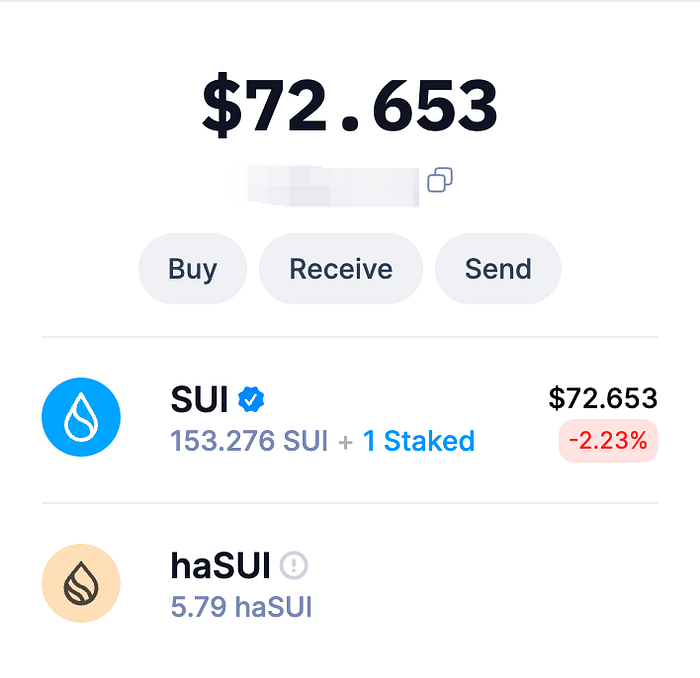
2\. When shown wallet options, choose the preferred option and connect. With your wallet connected, you can now view your balances.

<figure><img src="https://miro.medium.com/v2/resize:fit:700/1*0pBr05zEgmCWgfKNBi9ZFQ.png" alt="" height="679" width="700"><figcaption></figcaption></figure>

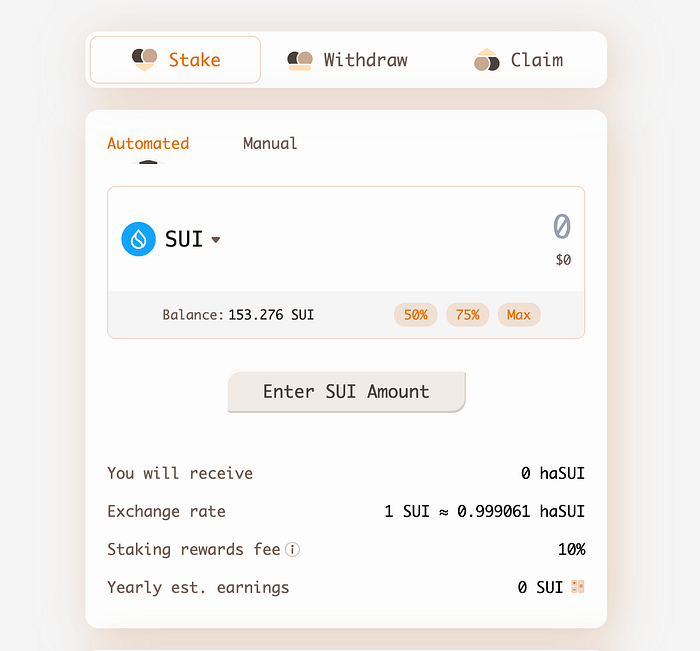
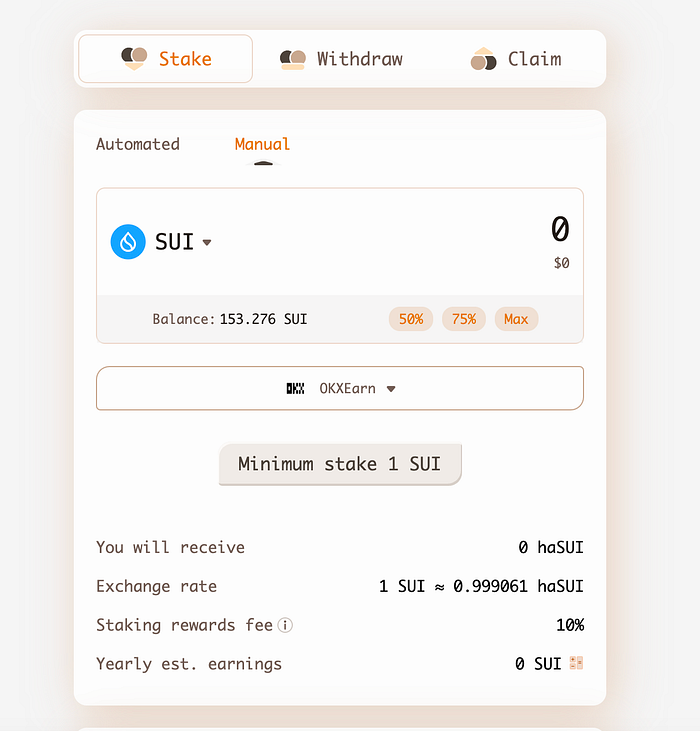
3\. There are two modes for users to choose — ‘**Automated**’ & ‘**Manual**’. **‘Automated’** mode allows users to stake their SUI/Native staked SUI on Haedal at one click with the most efficient validators suggested by Haedal. Enter the amount of SUI to stake and get haSUI in return.

<figure><img src="https://miro.medium.com/v2/resize:fit:700/1*v5cRV2fOErBN8TbLMzvGxw.png" alt="" height="652" width="700"><figcaption></figcaption></figure>

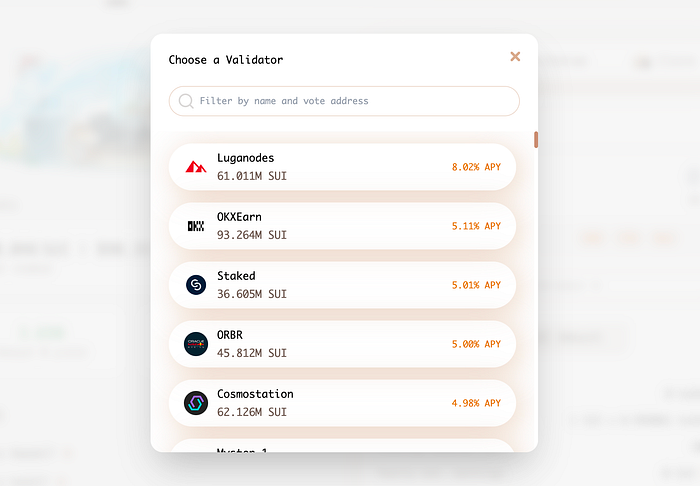
**‘Manual’ mode** allows users to stake SUI/staked SUI in their preferred validators with different levels of APY from the validator list.

<figure><img src="https://miro.medium.com/v2/resize:fit:700/1*mrZvF5WfYu2JJNJmB2iijQ.png" alt="" height="486" width="700"><figcaption></figcaption></figure>

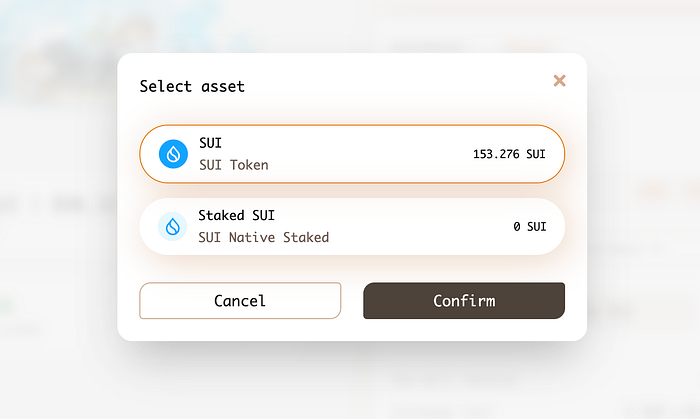
Users can either choose SUI or Native Staked SUI to stake on Haedal.

<figure><img src="https://miro.medium.com/v2/resize:fit:700/1*TFRgiB3jPzc_6FSpnwmrzQ.png" alt="" height="420" width="700"><figcaption></figcaption></figure>

Enter the amount of SUI or staked SUI to stake and get haSUI in return.

<figure><img src="https://miro.medium.com/v2/resize:fit:700/1*Xa9qKZklvuOmKBWhJ0EIVg.png" alt="" height="732" width="700"><figcaption></figcaption></figure>

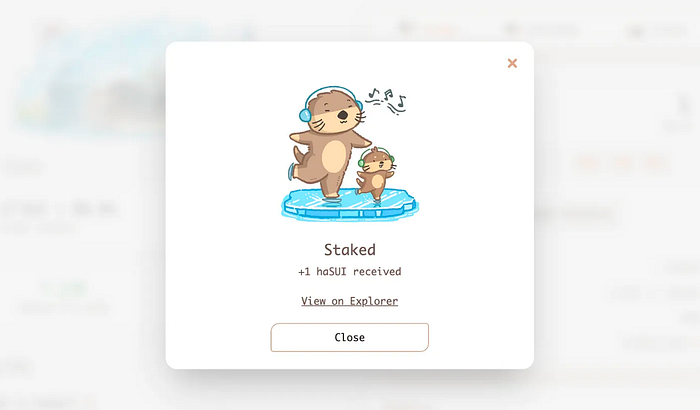
4\. Confirm the transaction using your wallet. Your wallet will now contain haSUI representing your staked deposit.

<figure><img src="https://miro.medium.com/v2/resize:fit:700/1*ODZLkPLYKawUrI_QSbIq7w.png" alt="" height="410" width="700"><figcaption></figcaption></figure>

5\. Your haSUI balance will be updated daily on the dashboard and wallet to reflect staking rewards.


# How to Withdraw

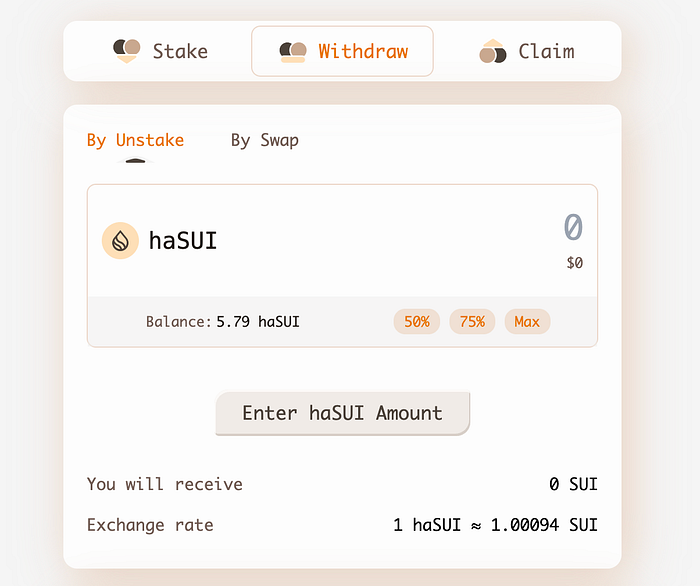
1. If you withdraw haSUI **by unstake**, enter the amount of haSUI and you can claim SUI after the unstake request is processed.

<figure><img src="https://miro.medium.com/v2/resize:fit:700/1*gaqBe7aiHespK9DYbH7MXg.png" alt="" height="587" width="700"><figcaption></figcaption></figure>

<figure><img src="https://miro.medium.com/v2/resize:fit:700/1*MoAlsl21zdpxe54ibGrQFQ.png" alt="" height="527" width="700"><figcaption></figcaption></figure>

2\. If you withdraw haSUI **by Swap**, you will receive SUI straightaway.

<figure><img src="https://miro.medium.com/v2/resize:fit:700/1*fRJWig38l8AAfCUIiBmwpw.png" alt="" height="762" width="700"><figcaption></figcaption></figure>


# Audit

View all audit reports:

<https://github.com/haedallsd/audit-report>


# Bug Bounty

Haedal is running a long-term bug bounty program powered by HackenProof.&#x20;

The DeFi security needs our joint effort. You are more than welcomed to submit your feedback if you discovered valuable findings.&#x20;

<https://hackenproof.com/programs/haedal-smart-contracts>